The History and Investment Legacy of the South African Krugerrand
When international gold breached historic records, soaring past R70,000 per ounce on global exchanges, seasoned bullion accumulators witnessed monetary history in motion. For modern investors, evaluating the true gold krugerrand history value provides essential insight into this global flight toward tangible wealth preservation. At the center of this financial movement sits a legendary coin: the South African Krugerrand.
However, evaluating bullion merely by its weight misses the true architecture of wealth preservation. Analyzing the gold krugerrand history value means seeing how an ingenious monetary design changed private investing forever. Consequently, the South African Mint and Rand Refinery transformed physical bullion from a restricted institutional asset into the cornerstone of modern retail portfolios.

The 1967 Genesis: Discovering the Gold Krugerrand History Value Under Bretton Woods
During the mid-1960s, the global monetary order rested on the Bretton Woods Agreement. Specifically, this system pegged foreign currencies to the United States Dollar at $35 per ounce of gold. Because of strict statutory controls, private citizens in many Western nations faced severe legal bans on hoarding raw gold bullion bars.
At the time, South Africa produced over 70% of the world’s gold supply. However, the South African government and the Chamber of Mines realized that central banks could not absorb long-term supply alone. In addition, the Bretton Woods system was beginning to fracture.
Therefore, in 1967, the South African Mint and the Rand Refinery launched the 1 oz Gold Krugerrand. This was not a mere commemorative medallion. Instead, it was the deliberate invention of sovereign retail bullion.
As a result, the Krugerrand solved a major legal hurdle. It allowed private citizens to own physical, investment-grade bullion legally under international law. Furthermore, issuing an official coin rather than an unrefined bar eliminated assay doubts for retail buyers. The intrinsic gold krugerrand history value earned instant global acceptance, effectively launching a new financial era.
Metallurgical Innovation: Engineering Gold Krugerrand History Value and Durability
In fact, the Krugerrand was never meant for velvet display boxes. Rather, it was engineered from the beginning as working money. Its technical specifications followed proven historic monetary standards:
- Gross Weight: 33.930 grams (1.0909 troy ounces)
- Fine Gold Weight: Exactly 31.1035 grams (1.0000 troy ounce)
- Alloy Composition: 91.67% pure gold (22-karat) and 8.33% copper
- Dimensions: 32.77 mm diameter, 2.84 mm thickness
Total Coin Mass: 33.930 g
├── Pure Fine Gold (91.67% / 22-Karat): 31.1035 g (1.0000 oz t)
└── Copper Alloy  (8.33% / Durability):  2.8265 g
Notably, choosing a 22-karat “crown gold” alloy mirrored the durability of the historic British Sovereign. Pure 24-karat gold is extremely soft. Consequently, it suffers scratches, clipping, and edge dings that degrade weight over time.
By blending pure gold with copper, the mint produced a tough, scratch-resistant coin. Therefore, this alloy ensures the coin retains its exact metallic mass across generations.
Historic Iconography: How Coin Design Enhances Gold Krugerrand History Value
Moreover, the coin’s visual identity highlights South African history and natural heritage:
- Obverse: Designed by Otto Schultz, it displays the profile portrait of Paul Kruger, four-term president of the historic South African Republic.
- Reverse: Sculpted by Coert Steynberg, it depicts a galloping Springbok antelope across the veld, surrounded by the mint year and gold purity markings.

The “No Face Value” Masterstroke: Dynamic Legal Tender and True Bullion Worth
In particular, the Krugerrand’s legal status was a brilliant monetary innovation. Traditional sovereign coins carry a fixed fiat face value. For example, a 1 oz American Gold Eagle displays an arbitrary $50 stamp.
In contrast, the Krugerrand carries no fiat denomination at all.
Under the South African Reserve Bank Act, the Krugerrand was designated official legal tender. However, its legal spending value floats directly with the daily spot market value of its fine gold content.
Consequently, this design provided three crucial market advantages:
- No Arbitrary Ceilings: The coin can never be devalued by statutory fiat inflation.
- Tax Harmonization: In addition, many international jurisdictions waived import duties and sales taxes on legal tender currency.
- Global Liquidity: It established transparent pricing worldwide. Thus, traders bought and sold coins strictly based on prevailing spot gold plus a minimal fabrication premium.
Ultimately, this monetary structure created the modern gold krugerrand history value standard that every rival mint later copied.
The 1970s Monopoly and Fractional Expansion: Broadening Retail Investor Worth
In 1974, the United States repealed its ban on private gold ownership. Meanwhile, high inflation gripped Western economies throughout the 1970s. As a result, demand for physical gold exploded.
Backed by global marketing campaigns from the International Gold Corporation, the coin became an icon. Consequently, by 1980, the Krugerrand controlled over 70% of the global physical bullion market. In that single year, the mint struck over 3 million ounces.
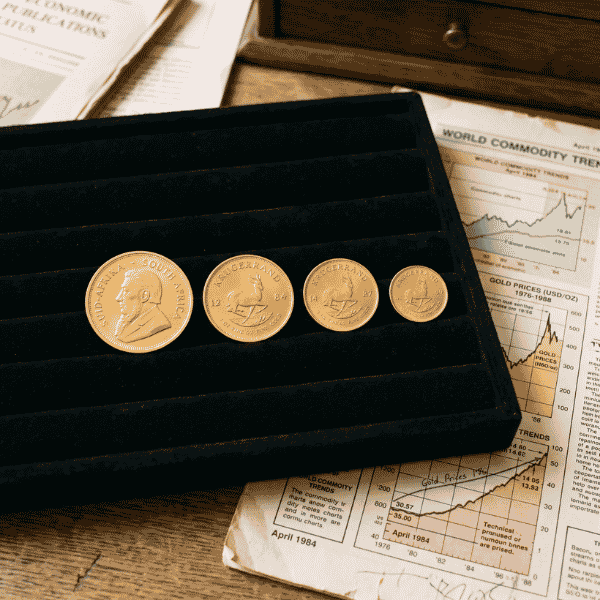
Furthermore, to keep gold accessible as spot prices surged toward $850 per ounce, the South African Mint introduced fractional sizes in 1980:
- 1/2 oz Krugerrand: Contains 15.552 g fine gold
- 1/4 oz Krugerrand: Contains 7.776 g fine gold
- 1/10 oz Krugerrand: Contains 3.110 g fine gold
Therefore, this move expanded retail access, setting the standard denominations used by sovereign mints worldwide today.
Sanctions and Competitors: How Embargoes Proved Krugerrand Market Resilience
However, the 1980s brought intense geopolitical disruption. Western nations enacted strict economic sanctions against South Africa’s apartheid policies. For instance, in 1986, the United States Congress passed the Comprehensive Anti-Apartheid Act. This law banned importing newly minted Krugerrands, and other Western governments soon followed with similar bans.
Crucially, these laws prohibited new imports, not existing ownership. Thus, millions of Krugerrands already in North America and Europe continued to trade freely among investors on secondary markets.
Supply Void (1980s Sanctions) ──► Sovereign Competitor Emergence:
                                  ├── 1979: Royal Canadian Mint (Gold Maple Leaf)
                                  ├── 1982: People's Bank of China (Gold Panda)
                                  ├── 1986: United States Mint (American Gold Eagle)
                                  ├── 1987: Royal Mint of the UK (Gold Britannia)
                                  └── 1989: Perth Mint of Australia (Gold Kangaroo)
Consequently, the resulting supply vacuum forced other sovereign mints to act. The Royal Canadian Mint launched the Gold Maple Leaf in 1979. Similarly, the United States Mint introduced the American Gold Eagle in 1986. Later, the British Royal Mint struck the Gold Britannia in 1987.
Paradoxically, these sanctions unintentionally gave birth to the modern sovereign bullion industry.
Following South Africa’s democratic transition in 1994, international bans ended. Therefore, the Krugerrand re-entered global distribution channels with its market reputation fully intact. Today, with over 60 million ounces minted, it remains the most traded bullion coin in history.
Intrinsic Metal Content vs. Numismatic Gold Krugerrand History Value
Investors must separate sovereign bullion from collectible coins when evaluating the gold krugerrand history value:
| Attribute | Standard Bullion Krugerrand | Numismatic / Proof Krugerrand |
| Primary Price Driver | Prevailing Gold Spot Price | Rarity, Year, Mintage Grade |
| Trading Premium | 2% to 6% over spot | 20% to 300%+ over spot |
| Target Investor | Wealth preservationists | Coin collectors, speculators |
| Global Liquidity | Immediate, two-way cash spreads | Selective, auction-dependent |
| Edge Serrations | 160 serrations | 220 serrations (Proof standard) |
For this reason, standard bullion Krugerrands offer the cleanest vehicle for long-term capital preservation. Investors pay solely for metal content rather than speculative historical premiums. As a result, this ensures total fungibility across global trading desks.
South African Macro Overlay: Preserving Purchasing Power and Bullion Value
For investors holding capital in South Africa, the Krugerrand plays a vital domestic role. Specifically, the South African Rand (ZAR) faces structural inflation and currency depreciation against major global reserve currencies.
Consequently, holding physical Krugerrands allows local investors to tie their wealth to an internationally priced commodity. Under the South African Reserve Bank framework, Krugerrands are legal tender. Therefore, domestic ownership does not require offshore foreign exchange tax clearances.
When international gold climbs while the Rand weakens, the domestic gold krugerrand history value compounds in local currency terms. Thus, it acts as a reliable shield for domestic savings.
Modern Trading: Maximizing Gold Krugerrand History Value Through ISA Gold
However, maximizing your investment returns requires disciplined execution. Historically, local retail buyers in South Africa faced steep dealer spreads of R3,000 to R4,000 per coin. Unfortunately, these high costs eroded short-term capital.
Traditional Retail Model:
[Buy at Spot + 6%] ──► [Wide Spread: R3,000 - R4,000] ──► [Sell at Spot - 4%]

Modern Active Trading Model (ISA Gold):
[Tight Spreads (~R500)] ──► [Direct Vault Settlement] ──► [Instant Liquidity]
Fortunately, modern institutional platforms have resolved these trading friction points:
- Tightened Pricing Spreads: Modern platforms like ISA Gold narrow spreads down to roughly R500 per coin. Therefore, this shifts bullion from an illiquid storehouse into an actively tradable asset.
- Accredited Sourcing: Acquiring coins directly through Rand Refinery-accredited supply chains removes counterparty risk. Furthermore, it guarantees verified metal authenticity.
- Insured Custodial Storage: While home safes appeal to self-custody purists, institutional vaulting provides certified Class 3 security. In addition, it offers comprehensive Lloyd’s-underwritten insurance and immediate settlement during sales.
- Regulatory Compliance: Trading through platforms registered with the Financial Intelligence Centre (FIC) ensures full adherence to anti-money laundering and tax standards.
To learn more about the corporate heritage behind this modern infrastructure, read Who Is ISA Gold and Who Owns It? The Complete Founder Story.
High-Intent Execution: Acquiring Krugerrands Through ISA Gold
For wealth preservationists seeking to secure physical gold positions efficiently, ISA Gold provides direct institutional access:
- Live Price Execution: Transact via transparent spot gold feeds paired with real-time ZAR conversion on the ISA Gold Live Pricing Desk.
- Fully Insured Vaulting: In addition, avoid domestic security vulnerabilities through secure, segregated storage options detailed in the ISA Vault Storage Solutions.
- Guaranteed Buyback Facility: Sell Krugerrand quickly at clear market rates using the ISA Gold Buyback Facility, thereby avoiding punitive dealer markdowns.
Whether building a multi-generational legacy reserve or hedging against currency volatility, the Krugerrand remains unmatched. Check account opening requirements and trade execution steps on the ISA Gold Getting Started Guide to speak directly with an accredited precious metals specialist.
The Enduring Power of the Krugerrand
More than five decades after its debut, the Krugerrand remains an essential financial asset. Indeed, it survived the collapse of Bretton Woods, geopolitical boycotts, and shifting market cycles.
Moreover, its durability, high global recognition, and legal tender architecture guarantee instant liquidity across every major exchange. By locking your capital into pure gold, the gold krugerrand history value continues to serve as an enduring foundation for private wealth preservation.

Frequently Asked Questions
Why does the 1 oz Krugerrand weigh more than 31.1 grams?
The Krugerrand contains exactly one troy ounce (31.1035 grams) of pure gold. However, it is struck in 22-karat crown gold alloyed with 8.33% copper. Therefore, the added copper raises the gross weight to 33.930 grams. As a result, this makes the coin durable against scratches without reducing its pure gold content.
Are Krugerrands subject to Capital Gains Tax (CGT) in South Africa?
Yes. Although Krugerrands are legal tender, the South African Revenue Service (SARS) treats bullion held for investment as capital assets. Consequently, disposals generating capital gains above annual statutory limits require standard Capital Gains Tax reporting upon realization.
How do I distinguish between a Proof Krugerrand and a Bullion Krugerrand?
The easiest indicator is the edge serrations. For example, a standard bullion Krugerrand features 160 serrations, while a Proof coin features 220 serrations. In addition, Proof coins exhibit mirror-like fields and frosted relief designs, commanding higher collector premiums.
Can I legally travel internationally with Krugerrands?
South African Reserve Bank exchange control regulations limit exporting legal tender gold coins. Therefore, both local residents and visiting foreigners must formally declare coins. Furthermore, they must secure written approval from an authorized foreign exchange dealer before traveling abroad.
This article is for general information only and isn’t financial advice. Always confirm live pricing directly with a registered dealer before transacting.