Does the Minting Year Affect the Krugerrand Coin Price? Why Investors Still Prefer Freshly Minted Coins
Put a Krugerrand struck in 1979 next to one minted last year, and most people assume the Krugerrand coin price must be higher for one of them. Some see the older coin as a collectible. Others treat it as second-hand and expect a lower kruger coin price.
For standard bullion coins, both views are usually wrong. Each coin holds exactly one troy ounce of fine gold, so the minting year generally doesn’t change what it’s worth.
Yet many investors still ask for freshly minted coins, and happily pay a little extra for them. That choice has less to do with gold and more to do with condition, convenience and confidence. Here’s how to decide which option makes sense for you.
Does the Minting Year Change the Krugerrand Coin Price?
No, not for bullion coins. Every 1 oz Krugerrand since 1967 contains 31.103 g of fine gold in a 33.93 g coin of 22-karat crown gold (91.67% gold, 8.33% copper). The South African Mint has kept that specification the same for almost 60 years.
That’s why the Krugerrand price today is built from the same three inputs, whatever the date:
- Gold spot price in US dollars per troy ounce, set in the global market and benchmarked by the LBMA
- The USD/ZAR exchange rate, which converts that dollar price into rands
- The dealer premium, which covers minting, distribution, insurance and the dealer’s costs
Put together, the kruger coin price works like this:
Price in rands = (gold spot price in USD per oz × USD/ZAR rate × fine gold in oz) + dealer premium
Nothing in that formula asks what year is stamped on the coin. A 1984 coin and a 2025 coin in similar condition track the same gold price, minute by minute. Check the live gold Krugerrand prices on ISA Gold to see it in action.
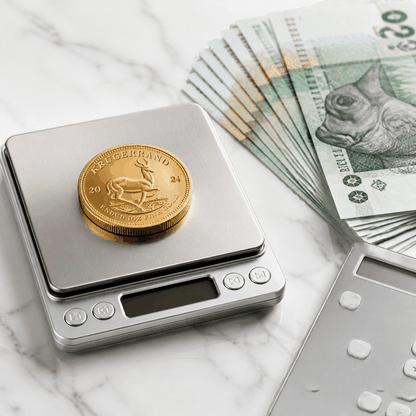
Krugerrand Minting Milestones and the Krugerrand Coin Price
The Krugerrand’s dates tell a great story, but for bullion coins they rarely move the price.
| Year | Milestone | Effect on bullion value |
|---|---|---|
| 1967 | First Krugerrand struck, one of the first modern gold bullion coins sold to private investors | None for bullion; first-year coins can attract collector interest |
| 1980 | 1/2 oz, 1/4 oz and 1/10 oz fractional Krugerrands introduced | Same 22-karat purity, smaller sizes |
| 1985 | The US bans Krugerrand imports under anti-apartheid sanctions; several countries follow | None today; restrictions were lifted in the early 1990s |
| 2017 | 50th anniversary; bullion coins carry a special privy mark | Can add a modest collector premium |
| 2027 | 60th anniversary (upcoming) | Worth watching for special releases |
Krugerrand Coin Price: Why Investors Still Prefer Freshly Minted Coins
If the gold is identical, the preference for new coins comes down to practical benefits that show up when you store, insure and eventually sell.
Better condition
The copper in a Krugerrand makes it tougher than pure gold coins, but decades of handling still leave marks. Older coins may show scratches, edge knocks, fingerprints or toning. New coins usually arrive bright and clean.
Original packaging
Current-year coins often come in mint capsules or sealed packaging. That protects the surface and makes storing your Krugerrands safely much simpler.
Smoother resale
When you sell your Krugerrands, the dealer checks weight, dimensions and authenticity. A pristine coin is quick to verify, so your offer tracks the Krugerrand price today closely. A badly damaged coin may be offered less.
Peace of mind
Buying a recent coin from a reputable dealer gives you a simple, clear chain of ownership. Fewer unknowns now means fewer questions later.
Gifting appeal
For a wedding, a birthday or a child’s first gold coin, a gleaming current-year Krugerrand looks the part. Some buyers go the other way and hunt for a coin from a birth year, which is one of the few times the date carries personal value.
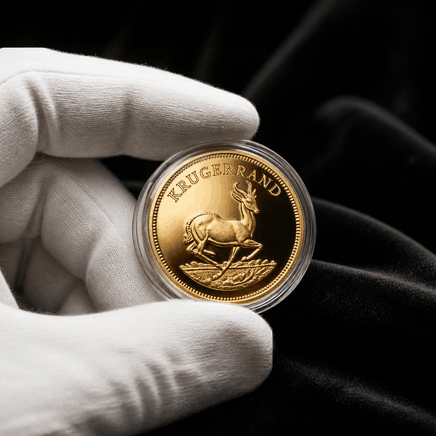
When the Minting Date Does Affect the Krugerrand Coin Price
The date moves the price only when a coin is valued as a collectible rather than as gold, or when its condition has suffered. That’s why dealers often show two figures: a mixed-date Krugerrand price today for coins of any year, and a slightly higher one for current-year coins.
| Coin type | Does the year affect value? | What drives the price | Best suited for |
|---|---|---|---|
| Current-year bullion | Slightly, through a higher premium | Gold content plus a condition premium | Gifting, easy resale, condition-focused buyers |
| Mixed-date bullion | No | Gold content | Investors maximising grams per rand |
| Older circulated or damaged bullion | Only through condition | Gold content, sometimes less a condition discount | Price-focused buyers comfortable with wear |
| Proof coins | Yes | Mintage, finish and collector demand | Collectors |
| First-year 1967 and privy-marked editions | Often | Rarity and collector demand | Collectors and special gifts |
If you’re paying a collector premium, independent grading from PCGS or NGC can confirm condition. For pure bullion investing, grading rarely pays for itself. Proofs are a separate market: their kruger coin price reflects scarcity and finish, not just ounces.
The South African Angle: How the Rand Drives the Krugerrand Coin Price
For South African investors, the biggest swing in the Krugerrand price today comes from the rand, not the year on the coin. Gold is priced in dollars, so when the rand weakens, the rand value of every Krugerrand rises, even if gold is flat in dollar terms. That rand-hedge effect has kept the coin a local favourite for decades.
Recent markets have made the hedge more visible. Gold broke through US$4,000 an ounce for the first time in October 2025, supported by strong central bank buying tracked by the World Gold Council. Add rand volatility, inflation figures from Stats SA and interest rate decisions from the South African Reserve Bank, and the date on your coin becomes a minor detail. What matters is how many grams you own and how efficiently you bought them.
For more on what moves prices from one day to the next, read Price of Krugerrand Today: How Global Events Influence Daily Coin Values.
Mixed-Date or Current-Year: Which Should You Buy?
- Choose mixed-date coins if you want the most gold for your rands and plan to hold for the long term.
- Choose current-year coins if you value condition, plan to give the coin as a gift, or want the simplest resale.
- Compare the gap. If a new coin’s kruger coin price is only slightly higher, the convenience is often worth it. If the gap is wide, mixed-date coins usually win.
Key Takeaways
- Bullion Krugerrands are valued on gold content, so the minting year generally doesn’t change the Krugerrand coin price .
- Freshly minted coins carry a small extra premium for condition, packaging and resale convenience.
- Mixed-date coins usually give you more gold per rand.
- Proofs, first-year 1967 coins and privy-marked editions are the exceptions, where rarity adds collector value.
- Condition matters more than age: heavy damage can lower the kruger coin price you’re offered.
- Buy from a dealer that labels each coin’s year and condition clearly.
Frequently Asked Questions
Is an older Krugerrand worth more than a new one?
Usually not. Bullion Krugerrands from every year contain one troy ounce of fine gold, so they share the same gold value. Older coins can be worth slightly less if damaged, or more if they’re proofs or rare dates.
Why are new Krugerrands more expensive than mixed-date ones?
Current-year coins carry a small extra premium for their condition, original packaging and easier resale. The gold inside is identical.
Are 1967 Krugerrands worth more?
First-year 1967 coins can attract collector interest, especially proofs in good condition. Standard 1967 bullion coins often trade close to gold value, so check with a dealer before paying extra.
Do scratches affect the Krugerrand price today?
Light marks rarely matter for bullion coins. Heavy scratches, dents or signs of tampering can lead to a lower offer, because the dealer has more to verify.
What’s the difference between a proof and a bullion Krugerrand?
Proofs are struck in small numbers with a mirror finish for collectors, so their kruger coin price includes a collector premium. Bullion coins are made in volume and priced mainly on gold content.
Buy the Gold, Then Choose the Finish
The year on a Krugerrand tells you when it was struck, not what it’s worth. For bullion coins, value comes from gold, the rand and a fair premium. Freshly minted coins earn their small extra cost through condition, packaging and an easier sale later, while mixed-date coins reward investors who simply want more ounces.
Decide which matters more to you, then compare the Krugerrand price today on ISA Gold for both options and buy with confidence.
Every gold Krugerrand at ISA Gold is a freshly minted coin, so you know exactly what you’re paying for. Prices follow the live market, and the same transparent process applies when you sell. Whether you start with a 1 oz Krugerrand or build up with Silver Krugerrands, you can check the Krugerrand price today before you commit. Curious about the people behind the platform? Read Who Is ISA Gold and Who Owns It? The Complete Founder Story.
This article is for general educational purposes only and does not constitute financial advice. Gold prices change continuously; always confirm current figures directly with a dealer or platform before transacting.
Images used across the ISA Bullion blogs are AI-generated for illustrative and creative purposes only. They do not represent the exact appearance, specifications, or final quality of actual ISA Bullion products.