The Definitive 1 oz Gold Krugerrand Value, Pricing & Melt Guide
Understanding the true gold krugerrand value requires looking past the daily international spot price headline. When institutional desk traders and private bullion investors trade South Africa’s flagship sovereign bullion coin, the transaction does not settle at raw commodity spot. Instead, realized value reflects a balance between intrinsic melt value, sovereign minting specifications, currency conversion rates, and primary dealer spreads.
Furthermore, recent commodity market dynamics, including global spot gold retesting record highs near $4,400–$4,600/oz in 2026 alongside ongoing fluctuations in the USD/ZAR cross rate, demonstrate why investors must master the quantitative mechanics of physical bullion pricing. As a result, mastering these core valuation metrics ensures that buyers and sellers protect their capital across every market cycle.
1. Anatomy of a 1 oz Coin: Gross Weight vs. Fine Gold Krugerrand Value
A frequent point of confusion among novice investors is the physical mass of the coin. A standard 1 oz Gold Krugerrand placed on a precision scale weighs 33.930 grams, not 31.103 grams.
Gross Weight: 33.930 g = Fine Gold Content (31.1035 g) + Copper Alloy (2.8265 g)
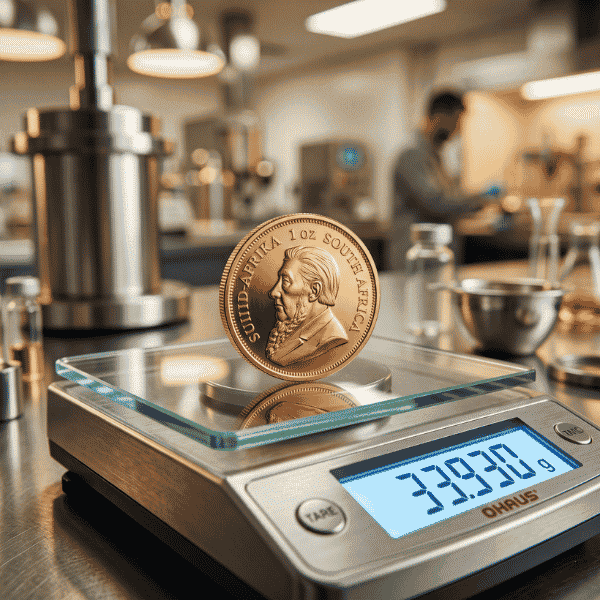
This disparity occurs because the coin is struck in 22-karat crown gold (91.67% gold purity and 8.33% copper). Consequently, the added copper provides its characteristic warm reddish hue while significantly increasing physical surface hardness. Despite the 33.930 g gross weight, however, the coin contains exactly one full troy ounce (31.1035 grams) of pure 24-karat equivalent gold. In other words, the total weight is higher simply to accommodate the copper alloy.
| Specification | Metric Measurement | Imperial / Fine Equivalent |
| Fine Gold Content | 31.1035 g | 1.0000 Troy Ounce |
| Gross Weight | 33.930 g | 1.0909 Ounces |
| Purity / Fineness | 916.7 / 1000 | 22 Karat (Crown Gold) |
| Diameter | 32.77 mm | 1.290 Inches |
| Thickness | 2.84 mm | 0.112 Inches |
| Alloy Metal | 2.8265 g | Pure Copper (Cu) |
Therefore, when determining the melt-equivalent gold krugerrand value, the copper component carries nominal value; calculations are pegged solely to the 1.0000 troy ounce of fine gold content.
2. Step-by-Step Spot-to-Melt Math: Calculating Gold Krugerrand Value
Melt value represents the baseline commodity value of the pure precious metal contained in the coin if melted and sold as raw raw bullion.
The Conversion Formula for Baseline Melt Value
To calculate the underlying melt value in local currency (ZAR), institutional desks apply the following equation:
$$\text{Melt Value (ZAR)} = \text{XAU/USD Spot Price} \times \text{Fine Gold Weight (1.0000 oz)} \times \text{USD/ZAR Exchange Rate}$$
Practical Model: Computing Real-Time Coin Worth
For instance, assuming an illustrative XAU/USD gold spot price of $4,500.00/oz and an exchange rate of R16.00 per US Dollar:
- Calculate Fine USD Melt Value:$$\$4,500.00 \times 1.0000 \text{ oz} = \$4,500.00$$
- Convert to Rand (ZAR) Melt Value:$$\$4,500.00 \times 16.00 = \text{R72,000.00}$$
Thus, this figure (R72,000.00) represents the raw intrinsic melt baseline, the theoretical price floor beneath which physical bullion rarely trades. In addition, this formula updates continuously during live trading sessions as exchange rates shift.
+-------------------------------------------------------------------------------+
|                       PRICING FLOW ARCHITECTURE                               |
|                                                                               |
|  [ Live XAU/USD Spot ] ---> [ USD/ZAR Exchange Rate ]                         |
|                                      |                                        |
|                                      v                                        |
|                        [ Intrinsic Melt Value Floor ]                         |
|                                      |                                        |
|            +-------------------------+-------------------------+              |
|            |                                                   |              |
|            v                                                   v              |
|   Retail Ask Price                                    Dealer Bid Price        |
| (Melt Value + 2% to 5% Premium)                     (Melt Value ± 1% Spread)  |
+-------------------------------------------------------------------------------+
3. The Institutional Valuation Framework: Melt Value vs. Settlement Price
In the physical marketplace, physical coins trade with a retail premium and a wholesale spread. Consequently, these markups reflect refining, minting, logistics, transit insurance, and dealer balance sheet costs.
                                  RETAIL SPREAD: 4.5%
                     |-------------------------------------------|
                     |                                           |
  [ Dealer Bid: R71,280 ] <--- [ Melt Floor: R72,000 ] ---> [ Retail Ask: R74,520 ]
       (-1.0% vs Spot)                 (Spot)                    (+3.5% vs Spot)
- Retail Ask Price (Buying): Primary distributors like Rand Refinery and the South African Mint strike and distribute coins to institutional dealers with a fabrication fee. Retail buyers typically pay +2% to +5% over spot.
- Dealer Bid Price (Selling): When liquidating to an authorized counterparty, institutional desks buy back standard-condition coins between -1% and +1% of spot, depending on regional inventory depth and supply dynamics.
- The Investor Spread: The delta between the ask and bid represents the hurdle the underlying market must cross before an allocation achieves net positive returns.

Illustrative Pricing Sequence
| Stage | Premium / Margin | Unit Price (USD) | Unit Price (ZAR) |
| 1. International Spot (XAU/USD) | Baseline (0.0%) | $4,500.00 | R72,000.00 |
| 2. Intrinsic Melt Value | 1.0000 oz Fine Au | $4,500.00 | R72,000.00 |
| 3. Retail Asking Price | +3.5% Dealer Premium | $4,657.50 | R74,520.00 |
| 4. Institutional Buyback Bid | -1.0% Buyback Floor | $4,455.00 | R71,280.00 |
| 5. Realized Bid/Ask Spread | 4.5% Net Difference | $202.50 | R3,240.00 |
To review institutional-grade allocations and view current buy/sell spreads, explore the ISA Gold live pricing board. Understanding platform operational backing is equally critical; discover our background in Who Is ISA Gold and Who Owns It? The Complete Founder Story.
4. The 22k Durability Premium: Krugerrands vs. 24k Bullion
When assessing long-term gold krugerrand value, physical resilience directly impacts secondary market settlement prices.
                         SECONDARY MARKET LIQUIDITY MATRIX

  COIN TYPE             DURABILITY / WEAR RESISTANCE        BUYBACK DISCOUNT RISK
  --------------------------------------------------------------------------------
  1 oz Krugerrand (22k) [====================] High         Low (Zero Wear Penalty)
  1 oz Eagle (22k)      [====================] High         Low (Zero Wear Penalty)
  1 oz Maple Leaf (24k) [=======             ] Low          Moderate (Surface Scuffs)
  1 oz Britannia (24k)  [=======             ] Low          Moderate (Edge Nicks)
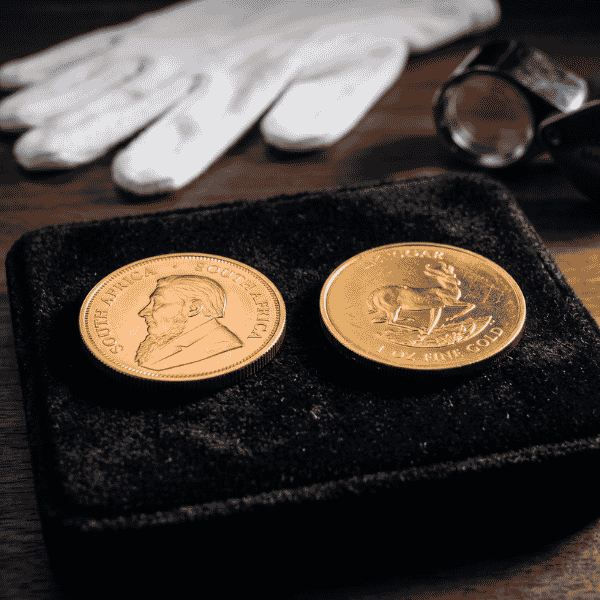
Pure 24k bullion coins, such as the Canadian Gold Maple Leaf or the Australian Gold Nugget via the Perth Mint, measure 99.99% pure gold ($0.9999$). Pure gold is soft and susceptible to edge dings, friction wear, and surface scratches during handling.
In contrast, the Krugerrand’s copper alloy hardens the planchet, preventing mass loss over decades of circulation.
- No Grading Penalties: A slightly handled 22k Krugerrand retains its full uncirculated bullion weight and premium.
- 24k Scuff Reductions: A scratched 24k coin may be discounted by secondary refiners down to wholesale scrap melt value (often -3% to -5% below spot) due to perceived weight loss or aesthetic degradation.
- Global Recognition: Introduced in 1967 as the world’s first modern ounce-denominated bullion coin, the Krugerrand maintains deep two-way liquidity across major trading hubs from Johannesburg to London and Zurich.
5. Currency Fluctuations: The South African Macro Factor
The rand price of gold is driven by two independent variables: the dollar price of gold and the USD/ZAR exchange rate monitored via the South African Reserve Bank.
$$\Delta \text{Local Gold Return} \approx \Delta \text{XAU/USD} + \Delta \text{USD/ZAR}$$
+-------------------------------------------------------------------------------+
|                      RAND DUAL-ENGINE PRICING MATRIX                          |
|                                                                               |
|   SCENARIO A: Gold Flat / ZAR Depreciates (10%)                               |
|   XAU/USD: $4,500 -> $4,500 (0.0%) | USD/ZAR: R16.00 -> R17.60 (+10.0%)       |
|   => Krugerrand Value: R72,000 -> R79,200 (+10.0% Rand Gain)                  |
|                                                                               |
|   SCENARIO B: Gold Rallies / ZAR Appreciates (Strong Rand Buffer)             |
|   XAU/USD: $4,500 -> $4,950 (+10.0%) | USD/ZAR: R16.00 -> R14.54 (-9.1%)      |
|   => Krugerrand Value: R72,000 -> R72,000 (Flat Rand Performance)             |
+-------------------------------------------------------------------------------+
For South African investors, this dynamic establishes the Krugerrand as a structural currency hedge. When domestic macroeconomic conditions exert downward pressure on the rand, the local gold krugerrand value can appreciate even during periods of sideways international spot price action.
6. Testing, Authentication, and Valuation Reductions
Secondary market buyback bids assume an authentic coin within standard mint tolerances. Physical testing verifies three parameters:
AUTHENTICATION TRIAD:  [ Gross Mass: 33.93 g ] <---> [ Dimensions: 32.77 x 2.84 mm ]
                                      ^
                                      |
                         [ Acoustic Resonance / Ultrasound ]
- Mass Verification: Must sit within mint tolerance of $33.930\text{ g} \pm 0.05\text{ g}$.
- Dimension Calipers: Diameter of $32.77\text{ mm}$ and thickness of $2.84\text{ mm}$. A counterfeit tungsten core coin matching the mass of gold will fail dimensional checks because tungsten’s density ($19.25\text{ g/cm}^3$) does not match 22k crown gold ($17.77\text{ g/cm}^3$).
- Electromagnetic / Ultrasound Verification: Non-destructive testing using tools like the Sigma Metalytics scanner measures bulk electrical conductivity to verify genuine 22k crown gold alloy throughout the core.
However, improperly cleaned coins, severe rim dings, or drill-tested bullion will inevitably trade at a discount to melt value because they require industrial melting at refiners rather than immediate commercial redistribution.
Strategic Bullion Execution with ISA Gold
To maximize long-term net yield, investors should always transact near spot through institutional market makers.
- Narrow Spreads: Access transparent two-way pricing aligned with international wholesale tiers via the ISA Gold product catalogue.
- Authenticity Guarantees: Every coin undergoes verified assay testing upon intake.
- Secure Custody: Direct integration with high-security vault facilities across South Africa.
For portfolio modeling and order execution, review our investor onboarding portal, consult our Krugerrand product guide, and inspect our bullion market analysis.
Key Takeaways
- Pure Gold Parity: The coin weighs 33.930 g gross to accommodate 2.8265 g of copper, containing exactly 1.0000 troy ounce (31.1035 g) of fine gold.
- Melt Value is the Floor: Intrinsic melt value represents raw commodity parity; retail purchase prices incorporate a 2% to 5% premium, while institutional liquidations clear close to spot.
- Durability Preserves Resale Value: The 22k crown alloy resists surface wear, avoiding the buyback condition penalties associated with delicate 24k sovereign coins.
- Dual Pricing Engine: Domestic returns reflect movements in both the international dollar spot price of gold and the USD/ZAR currency pair.

Frequently Asked Questions
What determines the daily 1 oz gold krugerrand value?
The value is calculated by multiplying the live XAU/USD gold spot price by the 1 troy ounce fine gold weight, converting the total to local currency via the prevailing exchange rate, and adjusting for dealer bid/ask premiums.
Why does a 1 oz Krugerrand weigh more than one ounce on a scale?
A 1 oz Krugerrand has a gross weight of 33.930 grams because it is struck in 22-karat crown gold (91.67% gold, 8.33% copper). The coin contains one full troy ounce (31.1035 grams) of pure gold, with the balance consisting of copper.
What is the typical dealer spread on a 1 oz Gold Krugerrand?
Standard retail spreads generally range from 3% to 6% between the buying price (ask) and the selling price (bid). High-volume institutional platforms like ISA Gold operate on tighter margins.
Is the gold krugerrand value subject to VAT in South Africa?
Under current South African tax legislation, legal tender bullion coins, including the 1 oz Gold Krugerrand, are classified as zero-rated financial assets for Value-Added Tax (VAT) purposes, avoiding the 15% consumption tax applicable to standard collectible items.
This article is for general information only and isn’t financial advice. Always confirm live pricing directly with a registered dealer before transacting.