How to Authenticate a Krugerrand: Physical Tests, Dimensions, and Counterfeit Red Flags
For most investors, the allure of the Gold Krugerrand lies in its status as the world’s most recognizable bullion coin. However, as global gold prices hit record highs in 2026, the incentive for bad actors to manufacture sophisticated counterfeits has never been greater; because of this, understanding how to authenticate a Krugerrand is an essential skill for every precious metals investor. Many buyers obsess over the spot price while ignoring the provenance of the asset itself, but relying on visual cues alone is a recipe for disaster. This guide provides the definitive field manual for protecting your wealth by verifying the physical and technical integrity of your gold.
If you are wondering how to authenticate a Krugerrand, you are already ahead of the curve. Many buyers obsess over the spot price while ignoring the provenance of the asset itself. Whether you are a seasoned “stacker” or a first-time buyer, relying on visual cues alone is a recipe for disaster. This guide provides the definitive field manual for protecting your wealth by verifying the physical and technical integrity of your gold.
The “22-Karat Trap”: Understanding Gross Weight When You Learn How to Authenticate a Krugerrand
The most common mistake made by novices is assuming a 1 oz Krugerrand should weigh exactly 31.1035 grams. This error stems from confusing “fine gold weight” with the “gross weight” of the coin.
The Krugerrand is struck in 22-karat gold (91.67% gold and 8.33% copper). The addition of copper is intentional, it provides the coin with its iconic reddish hue and superior durability against scratching. Consequently, a genuine 1 oz coin is heavier than a pure gold coin because it contains exactly one troy ounce of gold plus the copper alloy.
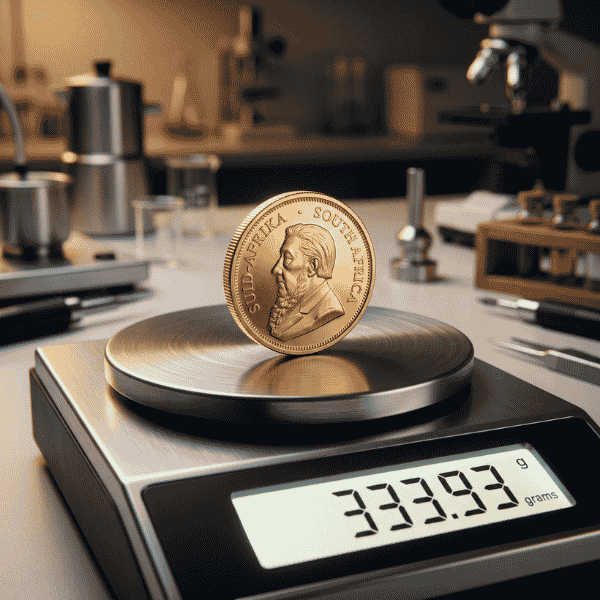
Official Krugerrand Specification Matrix for Those Asking How to Authenticate a Krugerrand
Use this table to verify any coin you hold. If your coin deviates by more than a negligible margin (due to minor wear), treat it as a red flag.
| Denomination | Fine Gold Content | Gross Weight | Diameter | Thickness |
| 1 oz | 1.000 oz | 33.930 g | 32.77 mm | 2.84 mm |
| 1/2 oz | 0.500 oz | 16.965 g | 27.00 mm | 2.24 mm |
| 1/4 oz | 0.250 oz | 8.482 g | 22.00 mm | 1.88 mm |
| 1/10 oz | 0.100 oz | 3.393 g | 16.50 mm | 1.35 mm |
A Step-by-Step Guide on How to Authenticate a Krugerrand Using Non-Destructive Tests
When learning how to authenticate a Krugerrand, you must move beyond the “eye test.” Professional verification involves a multi-stage approach known as triangulation.
Stage 1: Visual & Tactile Inspection
Examine the coin under a jeweler’s loupe. Real South African Mint coins exhibit razor-sharp relief.
- Portrait Detail: Look at Paul Kruger’s beard. The hair strands should be distinct, not “mushy” or blended.
- Edge Reeding: A genuine 1 oz Krugerrand has exactly 180 serrations (reeds) along the rim. If these are inconsistent, filed, or uneven, the coin is likely a cast fake.
- Finish: The surface should have a consistent luster. Discoloration or “pitting” suggests a base metal core covered in a thin gold plating.
Stage 2: Dimensional & Weight Checks: How to Authenticate a Krugerrand with Precision Tools
Use digital calipers and a precision scale (0.01g accuracy). If the weight is perfect but the diameter is off by even 0.5mm, the coin is likely a tungsten-core counterfeit. Tungsten has a density nearly identical to gold, meaning fake coins often “pass” a simple scale test but fail dimensional checks.
Stage 3: Acoustic & Magnetic Testing: How to Authenticate a Krugerrand via Physical Properties
- The Ping Test: Gold has a distinct, long-sustaining ring. Base metals sound dull or “thuddy.” Warning: Only perform this on a soft surface to avoid damaging the coin.
- Magnetic Slide: Gold is non-magnetic. Use a strong neodymium magnet on a tilted slide. A real coin will slide slowly due to eddy currents; a fake containing iron or nickel will stick or stop abruptly.
Stage 4: Advanced Electronic Verification
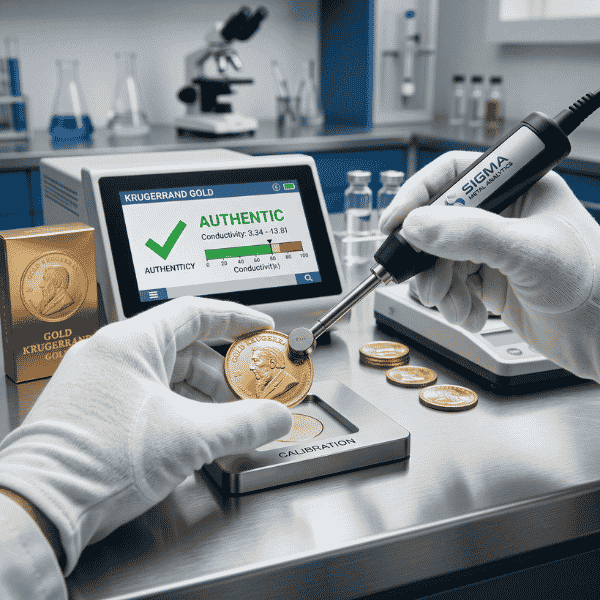
For total peace of mind, professional bullion dealers utilize Eddy Current Testers (like the Sigma Metal Analytics PMV). These devices measure the electrical resistivity of the metal deep beneath the surface, exposing non-gold cores instantly without damaging the coin.
High-Risk Counterfeit Red Flags
Even with these tests, stay vigilant. Recent reports from the London Bullion Market Association (LBMA) highlight an increase in high-quality “slabbed” fakes.
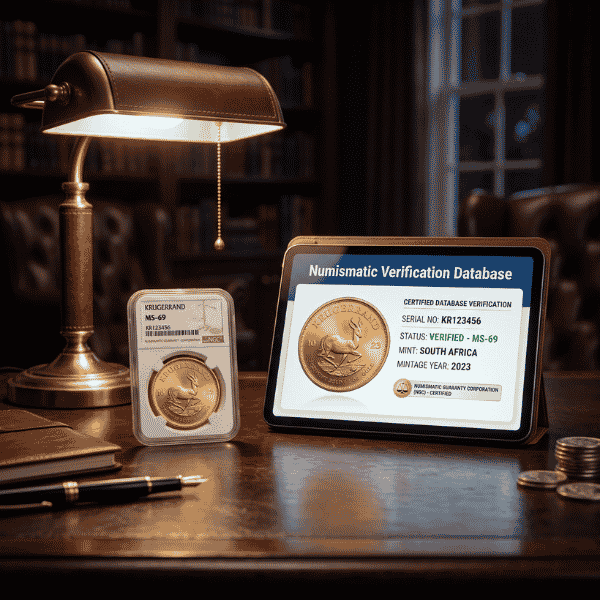
- Slab Fraud: Criminals place fake coins in counterfeit PCGS or NGC plastic holders. Always check the serial number against the official online PCGS Cert Verification database.
- Suspicious Pricing: If an offer is significantly below the current live gold price, it is likely a scam. In the world of precious metals, if a deal looks too good to be true, it almost certainly is.
- Lack of Provenance: Avoid private marketplace transactions (e.g., Facebook Marketplace, eBay) unless you have the tools to verify the coin in person.
Why Trust Matters: Trading with ISA Gold
Learning how to authenticate a Krugerrand is a vital skill, but the ultimate safety net is the supply chain itself. Buying from ISA Gold ensures you are receiving coins sourced directly from reputable refineries and official distributors.
Our commitment to transparency is outlined in our Founder Story, where we detail our mission to make gold investing in South Africa accessible and secure. When you trade Krugerrands with us, you receive a verifiable chain of custody and a transparent buyback guarantee, mitigating the risks associated with peer-to-peer trading.
Conclusion: Protect Your Capital
Authenticating a Krugerrand requires more than a glance; it demands a systematic approach using precision measurements and professional technology. By understanding the 33.93g weight rule and utilizing tools like calipers and magnets, you can filter out the vast majority of cheap fakes. However, to eliminate risk entirely, prioritize source over speculation. When you choose to buy gold online through a regulated dealer, you aren’t just buying metal, you are buying the certainty that your investment will retain its value for generations to come.
Frequently Asked Questions (FAQ)
How can I tell if a Krugerrand is real without a machine?
You can perform a visual inspection for sharp detail, verify the weight using a 0.01g scale (it should be 33.93g for a 1 oz coin), and conduct a magnetic slide test. However, these are not 100% foolproof against advanced tungsten fakes.
Does a magnet stick to a real Krugerrand?
No. Gold is non-magnetic. If a magnet sticks to your coin or stops it instantly on a slide, the coin is a counterfeit made of base metals like iron or nickel.
Why do some Krugerrands look more reddish than others?
Genuine Krugerrands contain 8.33% copper, which creates a natural reddish tint. Over time, coins may develop a light patina, which is normal for 22-karat gold coins.
Where is the safest place to buy Krugerrands in South Africa?
The safest method is to use LBMA-accredited dealers or official Rand Refinery distributors like ISA Gold, which provide assay receipts and guaranteed product authenticity.
View today’s live Krugerrand pricing and start investing safely.
Images used across the ISA Bullion blogs are AI-generated for illustrative and creative purposes only. They do not represent the exact appearance, specifications, or final quality of actual ISA Bullion products.